
DSLR Mounts: The Complete Guide to Lens Compatibility
Understand Canon EF, Nikon F, Pentax K, and Sony A-mount systems to choose the right lenses and adapters for your DSLR camera.
EXPLORE GEAR GUIDESWhy DSLR Mounts Matter: The lens mount is the mechanical and electronic interface between your camera body and lens. Choosing the right mount system determines your lens options, future upgrade path, and overall photography experience. Whether you're buying your first DSLR camera or expanding your kit, understanding mounts is essential.
What Is a DSLR Mount?
A DSLR mount is the physical bayonet or screw mechanism that attaches a lens to a digital single-lens reflex camera body. It ensures precise alignment between the lens and the image sensor, while also providing electronic contacts for autofocus, image stabilization, and aperture control. Each camera brand—and often each series within a brand—uses a proprietary mount system.
Understanding your camera's mount is critical when purchasing lenses. A lens designed for one mount system will not fit another without an adapter. This guide breaks down the major DSLR mount systems, their compatible cameras, and what you need to know before buying.
Major DSLR Mount Systems Explained
1. Canon EF Mount
Introduced in 1987, the Canon EF (Electro-Focus) mount is one of the most widely used DSLR mounts. It features a fully electronic interface with no mechanical aperture linkage, allowing for fast and silent autofocus. The EF mount has a flange focal distance of 44mm and a 54mm throat diameter.
- Compatible Cameras: Canon EOS DSLRs (e.g., EOS 5D, EOS 90D, EOS Rebel series)
- Lens Types: EF lenses (full-frame), EF-S lenses (APS-C only)
- Notable Features: Ultrasonic Motor (USM) and STM autofocus, image stabilization
- Adaptability: Easily adapted to mirrorless mounts like Canon RF, Sony E, and Nikon Z
The EF mount is known for its vast lens selection, from budget-friendly kit lenses to professional L-series glass. If you own a Canon DSLR, your lens options are virtually limitless.
2. Nikon F Mount
The Nikon F mount is one of the oldest and longest-running lens mounts, introduced in 1959. It has evolved through numerous iterations, from pre-AI to AI, AI-S, AF, AF-D, AF-S, and finally AF-P. The F mount has a flange focal distance of 46.5mm and a 44mm throat diameter.
- Compatible Cameras: Nikon DSLRs (e.g., D850, D780, D3500, D500)
- Lens Types: FX lenses (full-frame), DX lenses (APS-C)
- Notable Features: Silent Wave Motor (SWM), Vibration Reduction (VR)
- Adaptability: Can be adapted to Nikon Z and other mirrorless systems with varying degrees of functionality
Nikon F mount compatibility can be complex due to its long history. Older AI-S lenses may not meter properly on entry-level DSLRs, while AF-P lenses may not work on older bodies. Always check compatibility before purchasing.
3. Pentax K Mount
The Pentax K mount was introduced in 1975 and has remained largely unchanged, making it one of the most backward-compatible mounts in photography. It has a flange focal distance of 45.46mm and a 44mm throat diameter. Pentax K-mount lenses are known for their excellent build quality and weather sealing.
- Compatible Cameras: Pentax DSLRs (e.g., K-3 Mark III, K-1 Mark II, K-70)
- Lens Types: KAF4, KAF3, KAF2, KAF, KA, K lenses
- Notable Features: In-body image stabilization (IBIS), weather-resistant construction
- Adaptability: Limited adaptation options compared to Canon and Nikon
Pentax's commitment to backward compatibility means you can use decades-old lenses on modern DSLRs. This makes Pentax an attractive option for vintage lens enthusiasts.
4. Sony A-Mount
Sony's A-mount was originally developed by Minolta and acquired by Sony in 2006. It was used for Sony's DSLR and SLT (Single-Lens Translucent) cameras before the company shifted focus to mirrorless E-mount. The A-mount has a flange focal distance of 44.5mm and a 49.7mm throat diameter.
- Compatible Cameras: Sony A-mount DSLRs and SLT cameras (e.g., A99 II, A77 II, A68)
- Lens Types: Sony A-mount lenses, Minolta AF lenses
- Notable Features: Screw-drive autofocus on older lenses, SSM/SAM motors on newer lenses
- Adaptability: Can be adapted to Sony E-mount with the LA-EA series adapters
While Sony has largely discontinued A-mount development, the system still has a dedicated user base and a wide range of affordable used lenses.
DSLR Mount Comparison Table
Use this table to quickly compare the key specifications of each major DSLR mount system.
| Mount System | Flange Distance | Throat Diameter | Primary Camera Brands | Adaptability |
|---|---|---|---|---|
| Canon EF | 44mm | 54mm | Canon | Excellent |
| Nikon F | 46.5mm | 44mm | Nikon | Good |
| Pentax K | 45.46mm | 44mm | Pentax | Limited |
| Sony A | 44.5mm | 49.7mm | Sony, Minolta | Good |
How to Choose the Right DSLR Mount for Your Needs
When selecting a DSLR system, consider these factors:
- Lens Availability: Canon EF and Nikon F offer the widest selection of new and used lenses.
- Upgrade Path: If you plan to move to mirrorless, Canon EF and Nikon F adapt well to their respective mirrorless systems.
- Budget: Pentax K and Sony A-mount offer excellent value on the used market.
- Special Features: Pentax offers in-body stabilization across all lenses, while Canon and Nikon rely on lens-based stabilization.
For a broader overview of camera systems, visit our camera categories overview.
Lens Adapters and Speed Boosters for DSLR Mounts
If you want to use lenses from one mount system on a camera with a different mount, you'll need an adapter. There are two main types:
- Passive Adapters: Simple metal rings that allow you to mount a lens without electronic communication. These are inexpensive but require manual focus and aperture control.
- Electronic Adapters: These contain electronic contacts to enable autofocus, image stabilization, and aperture control. They are more expensive but offer full functionality.
For APS-C or Micro Four Thirds cameras, a speed booster can concentrate the image circle, effectively increasing the maximum aperture and restoring the original field of view. This is particularly useful when adapting full-frame lenses to smaller sensors.
When adapting lenses, always check the flange focal distance. A lens with a longer flange distance can be adapted to a camera with a shorter flange distance, but not vice versa. For example, Nikon F lenses can be adapted to Canon EF bodies, but Canon EF lenses cannot be adapted to Nikon F bodies without optical correction.
Maintaining Your DSLR Mount and Lenses
Proper care of your lens mount ensures reliable performance and prevents costly repairs. Here are some essential maintenance tips:
- Keep the Mount Clean: Use a blower or soft brush to remove dust from the mount and lens contacts. Avoid touching the electrical contacts with your fingers.
- Protect the Sensor: When changing lenses, turn off the camera and point the body downward to minimize dust entry. For sensor cleaning, refer to our sensor cleaning guide.
- Use Lens Caps and Body Caps: Always attach lens caps and body caps when the camera is not in use.
- Store Properly: Use a dry cabinet or silica gel to prevent moisture and fungus growth.
- Clean Lenses Regularly: Follow our lens cleaning guide to keep your glass pristine.
If you notice any damage to the mount or lenses, consult a professional repair service. Attempting DIY repairs on delicate electronic contacts can cause further damage.
Common Mistakes When Buying DSLR Lenses
Avoid these pitfalls when shopping for lenses for your DSLR mount:
- Assuming All Lenses Fit: Always verify the mount type before purchasing. A Canon EF lens will not fit a Nikon F body without an adapter.
- Ignoring Crop Factor: EF-S and DX lenses are designed for APS-C sensors. Using them on full-frame bodies may cause vignetting or damage.
- Overlooking Autofocus Compatibility: Some older lenses may not autofocus on newer DSLR bodies. Check compatibility charts.
- Forgetting About Stabilization: If your camera body lacks IBIS, you'll need lenses with built-in stabilization for sharp handheld shots.
- Not Budgeting for Accessories: Factor in the cost of UV filters, lens hoods, and camera bags.
For more buying advice, explore our camera buying mistakes guide and first camera checklist.
Recommended DSLR Mount Lenses & Adapters
⚠️ AFFILIATE DISCLOSURE: This website contains affiliate links. As an affiliate Associate, we earn from qualifying purchases. If you make a purchase through these links, we may receive a small commission at no additional cost to you. Read our full affiliate policy.

TARION Camera Desk Mount Overhead DSLR Arm Stand Titanrig Lite Z | Double C Clamp, 17.6 lbs Load Capacity, Extra Tablet Holder, 1/4" 3/8" Screw Adapter, for Selfie Live Streaming Videography
Check price on Amazon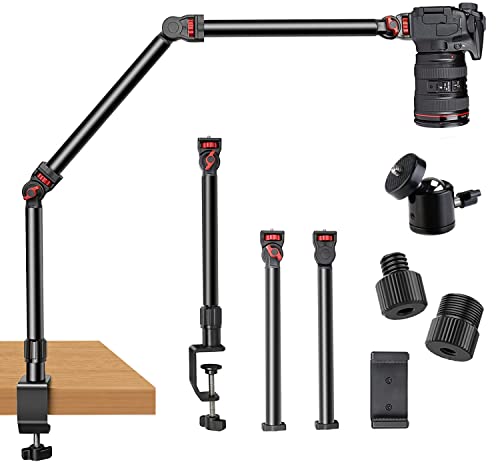
Overhead Camera Mount Desk Stand, 3-Section Detachable Articulating Arm | with 1/4“ 3/8" 5/8" Screw&360° Ball Head, C-clamp Tabletop Mount for DSLR Camera/Webcam/Microphone/Lights
Check price on Amazon
ULANZI Aluminum Camera Desk Stand Overhead Mount with Flexible Arm | 27.6in Center Shaft, 29.5in Extending Arm, Load 4.41lb, 3-Stage Adjustment, 360° Ball Head, for DSLR Ring Light Webcam
Check price on Amazon
HumanCentric DSLR Monitor Mount Small, Desk Camera Mounting | Light Webcam, Microphone Shelf for Monitor VESA Arm, Replace Clamp Tripods, 100x100mm Patterns, Aluminum, Hardware Included
Check price on Amazon
SMALLRIG Camera Mount C Stand, 15"-35" Adjustable Desk Clamp Table Tripod | Tabletop C Clamp Light Stand for Webcam, DSLR Camera, Ring Light, Live Streaming, Photo Video Shooting
Check price on Amazon
NEEWER Extendable Camera Desk Mount with Ball Head, 17"-40", TL283(RED) | Adjustable Table Light Stand, 1/4" Screw & C Clamp, for DSLR Camera, Ring Light, Live Stream, Vlog, Max Load: 6.6lb/3kg
Check price on Amazon
Ailight Overhead Camera Mount Desk Stand, 15.75"-33.45" Webcam Mount with 2-Section Adjustable Telescopic Boom Arm, C Clamp/Swiveling Ball Head for DSLR Camera, Ring Light, Webcam
Check price on AmazonFinal Thoughts on DSLR Mounts
Choosing the right DSLR mount system is a long-term decision that affects your entire photography journey. Canon EF and Nikon F offer the widest lens selection and best adaptability, while Pentax K and Sony A-mount provide unique advantages for specific users. By understanding flange distances, compatibility, and adapter options, you can build a versatile kit that grows with your skills.
Whether you're investing in your first DSLR camera or adding to your collection, always prioritize lenses that match your mount and shooting style. For more guidance, explore our lens and sensor hub and shopping and reviews hub.