
Night Vision Camcorder: The Ultimate Guide to Seeing in the Dark
Whether you're a hunter, a security professional, or a filmmaker pushing the boundaries of low-light cinematography, a night vision camcorder is your window into the invisible. Discover how to choose the right one for your needs.
Explore Top PicksWhat Exactly Is a Night Vision Camcorder?
A night vision camcorder is a specialized video recording device designed to capture footage in extremely low-light conditions, often in complete darkness. Unlike your standard smartphone or point-and-shoot camera, these camcorders use advanced technology to amplify existing light or detect heat signatures. This makes them indispensable for activities like hunting, wildlife observation, surveillance, and tactical operations. The core technology typically falls into two categories: image intensification (I2) and thermal imaging. While often associated with dedicated security systems like CCTV security cameras, the portability and recording capabilities of a camcorder offer unique advantages for dynamic, on-the-move scenarios.
How Night Vision Technology Works
Understanding the technology is key to choosing the right device. Most consumer and prosumer night vision camcorders rely on one of two primary methods:
🔦 Infrared (IR) Illumination
This is the most common and affordable method. The camcorder emits infrared light (invisible to the human eye) from a built-in IR illuminator. The camera's sensor is sensitive to this reflected IR light, effectively allowing you to "see" in the dark. The quality depends heavily on the strength of the IR illuminator and the sensor's low-light sensitivity.
- Pros: Affordable, compact, provides a clear monochrome image.
- Cons: Limited range (typically 30-100 yards), can be blocked by fog or smoke, the IR light can sometimes be seen by animals or other night vision devices.
🌡️ Thermal Imaging
Thermal camcorders don't need any light at all. They detect infrared radiation (heat) emitted by objects. This means they can see through smoke, fog, and light foliage, making them perfect for finding warm-blooded animals or people. The image is typically a thermal signature, not a traditional photographic image.
- Pros: Works in total darkness, can see through obscurants, excellent for detection and surveillance.
- Cons: Significantly more expensive, lower resolution for the price, cannot see through glass, image can be less intuitive to interpret.
Key Features to Look For in a Night Vision Camcorder
When comparing models, these specifications will make or break your experience:
| Feature | What It Means | Ideal For |
|---|---|---|
| IR Illuminator Range | The effective distance the built-in IR light can reach. Measured in yards or meters. | Hunters (50-100 yards), Security (20-50 yards) |
| Sensor Sensitivity (Lux) | A lower lux rating means the camera can see in darker conditions without IR. 0 Lux means it relies entirely on IR or thermal. | All night vision applications |
| Resolution (Video) | Standard is 1080p. Some higher-end models offer 4K. For thermal, resolution is typically lower (e.g., 320x240, 640x480). | 1080p is sufficient for most; 4K for detailed footage. |
| Optical Zoom | Magnifies the image without losing quality. Crucial for identifying targets at a distance. | Hunting, wildlife observation, surveillance |
| Recording Media | Most use SD cards. Check the maximum capacity supported. Some have internal storage. | Extended recording sessions |
| Battery Life | Night vision drains batteries quickly, especially with IR on. Look for models with long battery life or the ability to use external power banks. | Field use, long surveillance shifts |
| Connectivity | Wi-Fi, Bluetooth, or HDMI output for easy file transfer or live viewing on a larger screen. | Sharing footage, remote monitoring |
Choosing the Right Night Vision Camcorder for Your Needs
Your primary use case will dictate the best technology and features for you.
🏹 For Hunting & Wildlife
You need a balance of range, clarity, and durability. IR camcorders with a strong illuminator (80+ yards) and good optical zoom are excellent for scouting and recording game. Thermal is superior for detection but pricier. A dedicated hunting camcorder often includes features like recoil-activated recording.
- Key Specs: Long IR range, 10x+ optical zoom, rugged body, long battery life.
- Budget: $300–$1,500 (IR) / $1,500–$5,000+ (Thermal)
🛡️ For Home & Business Security
While fixed systems like wireless security camera systems are common, a portable night vision camcorder offers flexibility for temporary or covert monitoring. Look for models with wide dynamic range and motion detection. For a more permanent setup, consider a WiFi home security camera.
- Key Specs: Wide field of view, motion detection, Wi-Fi for remote viewing, discreet size.
- Budget: $150–$600
🎬 For Filmmaking & Content Creation
Filmmakers use night vision for a specific aesthetic or to capture scenes in near-darkness. You'll want a camcorder that can record in a flat, log-like profile for color grading, and outputs a clean image. A cinema camera with a night vision lens is the high-end option, but dedicated night vision camcorders are more accessible.
- Key Specs: Manual controls, high bit-rate recording, clean HDMI output, 24p/30p recording modes.
- Budget: $500–$3,000
🔍 For Tactical & Law Enforcement
Durability, reliability, and advanced features are paramount. These devices often include GPS, image stabilization, and the ability to withstand harsh environments. They are a specialized tool, often used alongside body cameras like a mini body camera.
- Key Specs: Military-grade durability, advanced image stabilization, GPS, excellent low-light performance.
- Budget: $1,000–$6,000+
IR vs. Thermal: Which Is Right for You?
Choose Infrared (IR) If...
- You have a limited budget.
- You need to identify targets clearly (IR gives a more "normal" image).
- You're operating in environments with some ambient light (moonlight, starlight).
- You don't need to see through smoke, fog, or heavy foliage.
Choose Thermal If...
- Your budget is flexible.
- You need to detect warm-blooded targets in complete darkness or through obscurants.
- Detection is more important than identification.
- You're working in a professional security or tactical capacity.
Recommended Night Vision Camcorders
⚠️ AFFILIATE DISCLOSURE: This website contains affiliate links. As an affiliate Associate, we earn from qualifying purchases. If you make a purchase through these links, we may receive a small commission at no additional cost to you. Read our full affiliate policy.
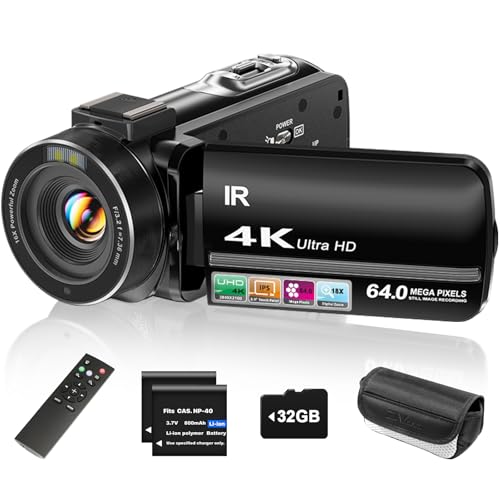
ZYDIIE 4K Video Camera Camcorder UHD 64MP Vlogging Camera for YouTube 18x Digital Zoom 3" 270° Rotation IPS Touchscreen Video Camcorder with Night Vision, Remote Control, 32GB Card, 2 Batteries
Check price on Amazon
Camcorder Video Camera 4K Ultra 80MP Vlogging Camera for YouTube | IR Night Vision,18X Digital Zoom, 3.0 IPS Screen, Recorder with 32GB SD Card, 2 Batteries, Microphone and Remote Control
Check price on Amazon
OLESIT 2.7K 64MP Video Camera Camcorder IR Night Vision YouTube Vlogging Camera Webcam 16X Digital Zoom 270° Rotation Screen with 16G SD Card,Battery
Check price on Amazon
Video Camera Camcorder Full HD 1080P 30FPS 24.0 MP IR Night Vision Vlogging Camera Recorder 3.0 Inch IPS Screen 16X Zoom Camcorders Remote Control with 2 Batteries
Check price on Amazon
5K Video Camera Camcorder, UHD 64MP Vlogging Camera for YouTube with 3" 270° Rotatable Touch Screen, Digital Camcorder with IR Night Vision, 16X Zoom/WiFi/Webcam/HD/32GB Card/2 Batteries/Microphone
Check price on Amazon
Video Camera, Full HD 1080P 30MP Camcorder, Vlogging Camera for YouTube | Blogging Camera Infrared Night Vision, 18X Digital Zoom 3.0“ LCD Screen Rcorder with Remote Control and Battery for Beginners
Check price on Amazon
8K 64MP Video Camera Camcorder 18X Zoom WiFi IR Night Vision Camcorders | 3.0'' Touch Screen Webcam Vlogging Camera for YouTube with 32GB SD Card, 2 Batteries, Remote Control, Mic and Stabilizer
Check price on Amazon
VETEK Video Camera 8k Camcorder 48MP UHD WiFi Vlogging Camera for YouTube | 18X Digital Zoom,IR Night Vision 3.0“ LCD Screen Digital Camera with Microphone, 32G SD Card, Remote Control and 2 Batteries
Check price on AmazonFinal Buying Tips for Your Night Vision Camcorder
Before you click "add to cart," keep these final considerations in mind:
- Don't Chase Megapixels: For night vision, sensor sensitivity (lux rating) is far more important than having 4K resolution. A 1080p camera with a great sensor will outperform a 4K camera with a poor one in low light.
- Check the IR Illuminator: The range and intensity of the IR light are crucial. Look for a model that matches the distance you typically need to view.
- Battery Life is King: Night vision camcorders are power-hungry. Always check the battery life under continuous IR use and consider a model that supports USB power banks.
- Consider a cheap video camera as a Backup: For daytime use, a simple, affordable camcorder can be a great companion to your specialized night vision gear.
- Explore Other Options: If you need a camera for both day and night, you might also consider a high-resolution mirrorless camera paired with a fast lens, or even a security camera for apartments that offers color night vision.
Ready to Master the Night?
You've got the knowledge. Now, take the next step and find the perfect night vision camcorder that fits your mission and your budget.
View Top Recommendations