
Thermal Camera Guide: See the Invisible, Decide with Confidence
Whether you are inspecting a home, securing a property, or exploring the outdoors at night, a thermal camera reveals what your eyes cannot see. This guide breaks down the technology, the key specifications, and the best models for every budget so you can choose the right thermal imaging device with certainty.
Explore Recommended Thermal CamerasWhat Is a Thermal Camera and Why Do You Need One?
A thermal camera, also known as a thermal imaging camera or infrared camera, detects infrared radiation (heat) and converts it into a visible image. Unlike standard cameras that rely on visible light, thermal cameras work perfectly in complete darkness, through smoke, and in adverse weather conditions. This makes them indispensable for professionals and homeowners alike.
If you are new to the world of advanced imaging, it helps to understand how thermal fits alongside other specialized tools. For instance, while a night vision binocular amplifies low light, a thermal camera detects heat signatures, making it far more effective for total darkness. Similarly, if you are considering a security surveillance camera for your property, adding a thermal model can provide detection capabilities that traditional cameras simply cannot match.
The applications are vast: home inspectors use them to find missing insulation, plumbers use them to detect hidden water leaks, electricians use them to identify overheating circuits, and security professionals use them for perimeter defense. For outdoor enthusiasts, a thermal camera can be a game-changer for wildlife observation and search-and-rescue operations, often complementing tools like a trail camera or a game camera.
How Thermal Imaging Works: The Basics You Should Know
Every object with a temperature above absolute zero emits infrared radiation. A thermal camera's sensor, called a microbolometer, captures this radiation and translates it into an electronic signal. The camera's processor then creates a thermogram—a color-coded image where different temperatures are represented by different shades or colors. Warmer objects typically appear white, yellow, or red, while cooler objects appear blue, purple, or black.
Understanding this process helps you evaluate specifications. The two most critical specs are resolution and thermal sensitivity.
- Resolution: Measured in pixels (e.g., 160x120, 320x240, 640x480). Higher resolution means more detail and the ability to detect temperature differences at greater distances. A 640x480 camera will show much finer detail than a 160x120 model.
- Thermal Sensitivity (NETD): Measured in millikelvins (mK). A lower number is better. A sensitivity of <50mK means the camera can detect temperature differences as small as 0.05°C, which is crucial for detecting subtle issues like moisture intrusion or minor electrical faults.
Other important features include the temperature range (e.g., -20°C to 550°C), accuracy, and the refresh rate. For dynamic scenes, a higher refresh rate (9Hz or 30Hz) provides smoother video.
Key Applications: Where a Thermal Camera Excels
Thermal cameras are not a one-size-fits-all solution. The best model for you depends entirely on your primary use case. Here are the most common applications and what to look for in each:
🏠 Home Inspection & Energy Audits
Find missing insulation, air leaks, and moisture intrusion. Look for a camera with good resolution (at least 160x120) and a temperature range that covers typical building envelope temperatures. A model with Wi-Fi and reporting software is a huge plus.
🔒 Security & Surveillance
Detect intruders in complete darkness or through light foliage. For security, prioritize detection range and integration with existing systems. A PTZ camera with thermal capabilities offers powerful pan-tilt-zoom monitoring. Standalone thermal security cameras are also excellent for perimeter defense.
⚡ Electrical & Mechanical Inspection
Identify overheating connections, faulty wiring, and mechanical wear before they cause failure. You need high thermal sensitivity (<50mK) and a temperature range that goes up to at least 400°C. A camera with manual focus and a laser pointer is very helpful for pinpointing exact locations.
🚗 Automotive & DIY
Diagnose brake issues, exhaust leaks, and electrical problems in vehicles. For DIYers, a compact, smartphone-attached thermal camera is often the most cost-effective and convenient option. It offers good enough resolution for most tasks without a huge investment.
🌲 Outdoor & Wildlife
Spot animals and people in total darkness. For hunting and wildlife observation, a dedicated thermal monocular or riflescope is ideal. These devices are rugged, portable, and optimized for long-range detection. They are a significant step up from a standard night vision binocular for pure darkness.
🔥 Firefighting & Search & Rescue
See through smoke and locate victims quickly. These cameras need high durability, a wide temperature range, and a large, bright display. Reliability and ease of use under pressure are paramount.
Recommended Thermal Cameras
⚠️ AFFILIATE DISCLOSURE: This website contains affiliate links. As an affiliate Associate, we earn from qualifying purchases. If you make a purchase through these links, we may receive a small commission at no additional cost to you. Read our full affiliate policy.

TOPDON TC004 Mini Thermal Imaging Camera, 240 x 240 TISR Resolution | 15H Battery Life, 25Hz Handheld Infrared Camera with High/Low Temp Alerts, Auto Shutdown, 128 x 128 IR Resolution, Blue
Check price on Amazon
Flagfront Thermal Camera, 240 x 240 TISR Resolution for Home Inspection | 25Hz Refresh Rate , -4°F to 1022°F Temp Range with High/Low Temperature Alarm, 50°FOV Handheld Thermal Imaging Camera
Check price on Amazon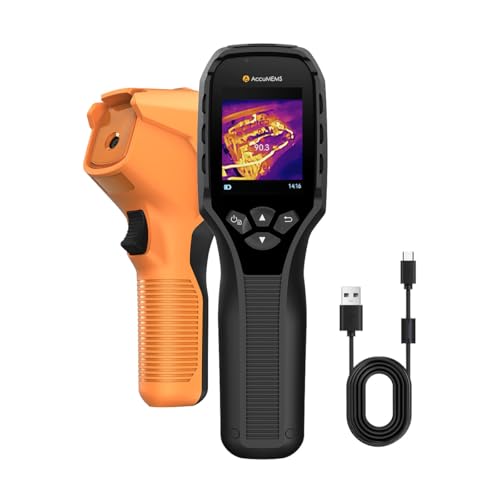
GT14S Thermal Imaging Camera with Edge Enhancement, Thermometer Mode | Infrared Camera -4°F to 1202°F Range, 240g Compact Design, 25Hz Image Frequency, 14H Runtime for HVAC/Home Inspection
Check price on Amazon
Thermal Master Thor002 Thermal Camera, 3.5" IPS Screen, ±3.6℉ Accuracy | 512×384 X³ IR Resolution, 5 Imaging Modes, -4°F to 1022°F, PC Analysis, Thermal Imager for Electrical Inspection
Check price on Amazon
TOPDON TC004 3.5" Thermal Imaging Camera, -4°F~1022°F Temp Range | 512 x 384 TISR Resolution, 8-Hour Battery Life Handheld Infrared Camera with PC Analysis and Video Recording, 64GB Storage
Check price on Amazon
AccuMEMS GT14S Thermal Imaging Camera, Thermometer Mode, Ultra-Light 240g | 4°F~1022°F Range, 14H Runtime, Live Tracking with Edge-Enhanced Display, Infrared Camera for HVAC/Electrical Inspection
Check price on Amazon
AMPBANK H128 Thermal Camera, 240 x 240 TISR Resolution, 24H Battery Life | 25 Hz Infrared Camera, Smart Temp Alarm, Drop-Proof Durable Thermal Imaging Camera for HVAC Electrical Building Inspection
Check price on Amazon
HSFTOOLS F2VW Thermal Camera with 2MP Visual Cam, 640x480 Super Resolution | 3.2" Screen Thermal Imaging Camera, Intelligent Scene Detection, 256x192 Native IR Dual-Camera Thermal Imager, 16 GB, Case
Check price on AmazonHow to Choose the Best Thermal Camera for Your Needs
With so many options available, narrowing down your choice can be overwhelming. Use this checklist to make a confident decision.
1. Define Your Primary Use Case
Are you a professional inspector who needs detailed reports, or a homeowner who wants to find a draft? Your use case dictates the required resolution and features. A professional will need a higher-resolution camera (320x240 or 640x480) with advanced software, while a casual user can be well-served by a lower-resolution model or a smartphone attachment.
2. Set a Realistic Budget
Thermal camera prices vary widely based on resolution and features. Here is a general guide to current market pricing:
- Smartphone Attachments & Entry-Level: $200–$500. Great for DIYers and basic home checks.
- Mid-Range Handheld: $500–$2,000. The sweet spot for serious DIYers and many professionals. Offers resolutions from 160x120 to 320x240.
- Professional-Grade: $2,000–$5,000+. High-resolution (320x240 to 640x480+), advanced features, and superior software.
- Specialty (Security, Hunting, Firefighting): Prices can range from $1,000 to over $10,000 depending on range, durability, and integration.
While a high-end camera is a significant investment, it can pay for itself quickly in professional settings. For hobbyists, a mid-range or smartphone model offers an excellent balance of performance and value. If you are also looking for a general-purpose digital camera or a video camera for other projects, it often makes sense to allocate a separate budget for those rather than expecting one device to do everything.
3. Prioritize Resolution and Sensitivity
These two specs have the biggest impact on performance. As a rule of thumb, buy the highest resolution and lowest NETD you can afford. A 320x240 resolution camera with <50mK sensitivity will outperform a 640x480 camera with a poor 100mK sensitivity in many real-world scenarios.
4. Consider Form Factor and Durability
Do you need a rugged, waterproof model for outdoor use, or a compact one that fits in your pocket? For security integration, a fixed-mount camera is best. For fieldwork, a handheld with a good battery life is essential. If you plan to use it in wet environments, check the IP rating.
Thermal Camera Categories at a Glance
This table summarizes the key differences between the main types of thermal cameras to help you quickly identify which category fits your needs.
| Category | Typical Resolution | Best For | Price Range |
|---|---|---|---|
| Smartphone Attachment | 80x60 to 160x120 | DIY, basic home checks, hobbyists | $200–$500 |
| Entry-Level Handheld | 160x120 | Homeowners, basic inspections | $300–$800 |
| Mid-Range Handheld | 256x192 to 320x240 | Serious DIYers, electricians, plumbers | $800–$2,000 |
| Professional Handheld | 320x240 to 640x480+ | Building inspectors, engineers, researchers | $2,000–$6,000+ |
| Thermal Security Camera | Varies (often 320x240 or 640x480) | Perimeter security, 24/7 monitoring | $1,000–$5,000+ |
| Thermal Monocular / Scope | 320x240 to 640x480+ | Hunting, wildlife, search & rescue | $1,500–$8,000+ |
Continue Your Research
Frequently Asked Questions About Thermal Cameras
No, a thermal camera cannot see through solid walls. It detects surface temperature differences. However, it can reveal temperature patterns on a wall that indicate what is happening behind it, such as missing insulation, hidden pipes, or structural heat loss. This is why it is an invaluable tool for building diagnostics.
The terms are often used interchangeably, but technically, "infrared" refers to the entire spectrum of radiation beyond visible red light. "Thermal" specifically refers to the far-infrared portion of that spectrum, which is emitted by objects as heat. So, all thermal cameras are infrared cameras, but not all infrared cameras are thermal (e.g., a TV remote uses near-infrared).
It depends on your task. For quickly scanning a large area to find a major heat loss, a lower resolution (e.g., 160x120) is fine. For detailed inspection of electrical components or precise temperature measurement of small objects, a higher resolution (320x240 or 640x480) is necessary. Higher resolution also allows you to stand further away from the target.
For professionals, absolutely. A single inspection that identifies a serious electrical fault or a major energy leak can save thousands of dollars, paying for the camera many times over. For homeowners, a lower-cost model is a worthwhile investment for DIY energy audits and problem-solving. For casual hobbyists, a smartphone attachment offers a fun and useful entry point.
Yes, thermal monoculars and riflescopes are extremely popular for hunting, especially for predators and wild boar at night. They allow you to detect game in complete darkness and through light brush. Check your local regulations, as the use of thermal imaging for hunting may be restricted in some areas. For general wildlife observation, they are also an incredible tool.