
Camera ND Filter Guide: Master Light Control & Long Exposures
A neutral density (ND) filter is one of the most versatile tools in photography. It reduces the amount of light entering your lens without changing the color of the scene, giving you creative control over shutter speed, aperture, and depth of field.
Find Your ND FilterWhy Every Photographer Needs an ND Filter: Whether you shoot landscapes, portraits, or video, an ND filter lets you use slower shutter speeds in bright conditions. This means silky-smooth waterfalls, motion-blurred clouds, and cinematic video with natural motion blur — all without overexposing your images.
What Is a Camera ND Filter and How Does It Work?
Understanding Neutral Density
A camera ND filter is a piece of tinted glass that screws onto the front of your lens or slides into a filter holder. It reduces the intensity of all wavelengths of light equally, meaning it doesn't add any color cast. Think of it as sunglasses for your camera lens.
Unlike a polarizing filter or CPL filter, which affects specific light waves and enhances contrast, an ND filter simply cuts the amount of light. This makes it an essential tool for any photographer who wants to control exposure creatively.
Why Use an ND Filter?
In bright daylight, even at your camera's lowest ISO and smallest aperture, you may still be forced to use a shutter speed that's too fast for creative effects. An ND filter solves this problem by allowing you to:
- Use slow shutter speeds for long exposure photography
- Shoot at wide apertures in bright light for shallow depth of field
- Create motion blur in waterfalls, clouds, and crowds
- Reduce flicker when shooting video under artificial lights
- Achieve cinematic motion blur in video at 24fps or 30fps
ND Filter Stops Explained: Choosing the Right Density
ND filters are measured in stops of light reduction. Each stop halves the amount of light reaching your sensor. The table below shows the most common ND filter densities and their typical uses.
| ND Filter | Stops Reduced | Light Transmission | Best For |
|---|---|---|---|
| ND2 | 1 stop | 50% | Portraits in bright light, slight motion blur |
| ND4 | 2 stops | 25% | Waterfalls, moderate long exposures |
| ND8 | 3 stops | 12.5% | Silky water, cloud movement, video |
| ND16 | 4 stops | 6.25% | Strong motion blur, bright daylight long exposure |
| ND32 | 5 stops | 3.12% | Very long exposures, dramatic cloud streaks |
| ND64 | 6 stops | 1.56% | Extreme long exposures, removing crowds |
| ND1000 | 10 stops | 0.1% | Ultra-long exposures (minutes), surreal effects |
💡 Pro Tip: For video work, a variable ND filter (VND) is often more practical than a fixed ND filter. It lets you adjust density on the fly without swapping filters. Look for a VND with a range of 2 to 8 stops for maximum flexibility.
Types of ND Filters: Fixed, Variable, and Graduated
Fixed ND Filters
Fixed ND filters offer a single, specific light reduction. They are the most affordable and often provide the best optical quality because there are no moving parts. If you frequently shoot in similar lighting conditions, a set of fixed ND filters (ND8, ND64, ND1000) is a solid investment.
Variable ND Filters (VND)
Variable ND filters consist of two polarizing layers that rotate against each other to adjust density continuously. They are incredibly convenient for run-and-gun video and changing light conditions. However, cheap VNDs can introduce color casts or cross-polarization artifacts at extreme settings.
Graduated ND Filters (GND)
Graduated ND filters are dark at the top and clear at the bottom, with a gradual transition. They are designed for landscape photography where the sky is much brighter than the foreground. A soft-edge GND is ideal for uneven horizons, while a hard-edge GND works best for flat horizons like seascapes.
ND Filter Systems: Screw-On vs. Square
Screw-on ND filters attach directly to your lens thread and are compact and convenient. Square filter systems use a holder that accepts different filter sizes, making them ideal if you own multiple lenses with different thread sizes. They also allow you to use graduated ND filters effectively.
Pros and Cons of Using ND Filters
✓ Advantages
- Enables long exposures in bright daylight
- Allows wide apertures for shallow depth of field
- Creates motion blur for artistic effect
- Improves video quality by maintaining 180-degree shutter rule
- Non-destructive — no effect on color or contrast
- Available in a wide range of densities and sizes
✕ Limitations
- Can be expensive, especially high-quality glass
- Cheap filters may introduce color casts
- Requires additional accessories like step-up rings
- Variable ND filters can cause cross-polarization
- Adds an extra layer of glass that may reduce sharpness slightly
- Requires manual exposure adjustments
How to Choose the Best Camera ND Filter for Your Needs
1. Determine Your Filter Thread Size
Check the front of your lens for a number followed by the "Ø" symbol (e.g., Ø77mm). This is your filter thread size. If you have multiple lenses with different thread sizes, consider buying filters for your largest lens and using step-up rings for smaller lenses.
2. Choose Your Density
For general landscape photography, an ND64 (6-stop) or ND1000 (10-stop) is a great starting point. For video, a variable ND filter with a 2–8 stop range is ideal. If you shoot portraits in bright light, an ND8 (3-stop) is often sufficient.
3. Consider Optical Quality
Look for filters made from high-quality optical glass with multi-resistant coatings. These coatings reduce reflections, repel water and dust, and minimize the risk of ghosting and flare. Brands like B+W, Hoya, and Breakthrough Photography are known for their excellent quality.
4. Decide on Screw-On vs. Square
If you only use one or two lenses, screw-on filters are convenient and cost-effective. If you use multiple lenses or want to use graduated ND filters, a square filter system with a holder is more versatile in the long run.
💡 Budget Tip: If you're just starting out, a CPL filter combined with a simple ND8 filter can cover most of your creative needs without breaking the bank. For those looking to upgrade their camera body first, check out our guide to affordable DSLRs or budget-friendly mirrorless cameras.
ND Filter Best Practices for Stunning Results
Use a Tripod
When using slow shutter speeds, a sturdy tripod is essential to keep your images sharp. Even the slightest vibration can blur a 30-second exposure. Pair your tripod with a remote shutter release or use your camera's self-timer to avoid shake.
Cover Your Viewfinder
Light can leak through your camera's viewfinder during long exposures, causing unwanted streaks or haze. Most cameras include a viewfinder cover for this purpose. If not, a piece of black tape works perfectly.
Calculate Your Exposure
Use the formula: New Shutter Speed = Original Shutter Speed × 2^(Stops). For example, if your original shutter speed is 1/250s and you add a 6-stop ND filter, your new shutter speed becomes 1/250 × 64 = 1/4s. Many smartphone apps can do this calculation for you.
Focus Before Filtering
With very dark ND filters (10-stop and above), your camera may struggle to autofocus. Focus on your subject first, then switch to manual focus and carefully attach the filter without moving the focus ring.
Creative Applications of ND Filters
Landscape Photography
ND filters are indispensable for landscape photographers. They allow you to capture ethereal, misty waterfalls, streaking clouds across a dramatic sky, and glassy seascapes. A 10-stop ND filter can turn a choppy ocean into a smooth, dreamlike surface.
For more landscape inspiration, explore our wide-angle lens guide to find the perfect lens for your ND filter.
Portrait Photography
In bright sunlight, ND filters let you shoot at wide apertures (like f/1.4 or f/1.8) to achieve beautiful background separation. A 3-stop or 4-stop ND filter is usually enough for most portrait situations. Pair it with a 50mm prime lens for stunning results.
Video Production
For cinematic video, the 180-degree shutter rule states that your shutter speed should be double your frame rate (e.g., 1/48s for 24fps). In bright daylight, this is impossible without an ND filter. A variable ND filter is the go-to choice for videographers.
If you're into vlogging, check out our guide to the best 4K vlogging cameras.
Astrophotography
While ND filters are not used for shooting stars directly, they can help you create dark frames and calibration frames for astrophotography. More importantly, they help you practice long exposures during the day to prepare for night shoots. Learn more in our astrophotography guide.
Recommended Camera ND Filters
⚠️ AFFILIATE DISCLOSURE: This website contains affiliate links. As an affiliate Associate, we earn from qualifying purchases. If you make a purchase through these links, we may receive a small commission at no additional cost to you. Read our full affiliate policy.

K&F CONCEPT 82mm Variable ND2-400 Lens Filter (1-9 Stops) for Camera Lens | Ultra Slim Adjustable Neutral Density Filter with Microfiber Cleaning Cloth (B-Series) FN101
Check price on Amazon
K&F CONCEPT 67mm Variable ND2-400 Lens Filter (1-9 Stops) for Camera Lens | Ultra Slim Adjustable Neutral Density Filter with Microfiber Cleaning Cloth (B-Series) FN101
Check price on Amazon
K&F CONCEPT 55mm Variable ND2-400 Lens Filter (1-9 Stops) for Camera Lens | Ultra Slim Adjustable Neutral Density Filter with Microfiber Cleaning Cloth (B-Series) FN101
Check price on Amazon
K&F CONCEPT 82mm True Color Variable ND2-32 & Polarizer in 1 Lens Filter | 1-5 Stops Variable Neutral Density Polarizing Effect in 1 with 28 Multi-Coated for Camera Lens (Nano-X Series) FA702
Check price on Amazon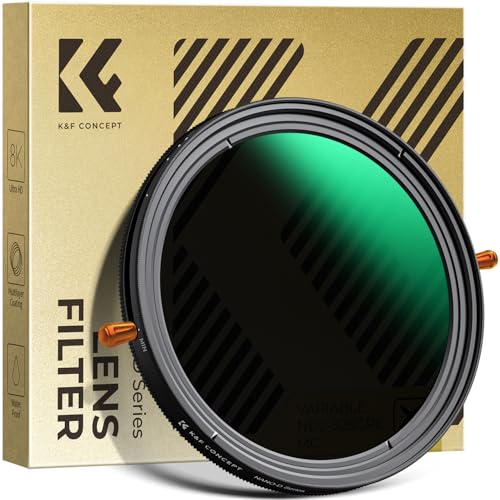
K&F CONCEPT 67mm Variable ND2-32 & CPL Polarizing Effect in 1 Lens Filter | 24 Multi-Coated Waterproof 1-5 Stops Adjustable Neutral Density Polarizer Filter (Nano-D Series) FA501
Check price on Amazon
K&F CONCEPT 67mm Variable ND Lens Filter ND2-ND400 (1-9 Stops) Ultra Slim | 18 Multi-Layer Coatings Adjustable Neutral Density Ultra Slim Lens Filter for Camera Lens (K-Series) FN303
Check price on Amazon
K&F CONCEPT 77mm Variable ND2-400 Lens Filter (1-9 Stops) for Camera Lens | Ultra Slim Adjustable Neutral Density Filter with Microfiber Cleaning Cloth (B-Series) FN101
Check price on Amazon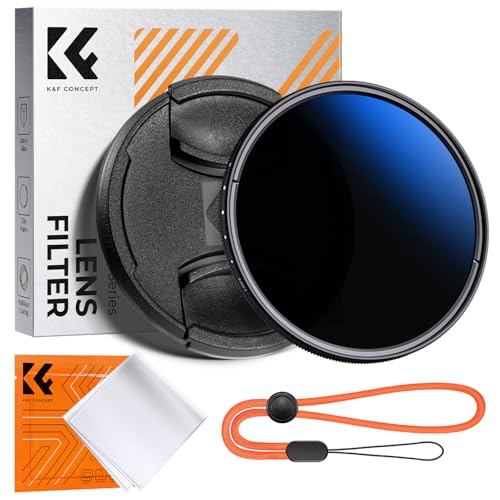
K&F CONCEPT 58mm Variable ND2-400 Lens Filter+Filter Cap+Cleaning Cloth | 18 Multi-Layer Coatings 1-9 Stops Adjustable Neutral Density Ultra Slim Camera Lens Filter (K-Series) FN303
Check price on AmazonFrequently Asked Questions About Camera ND Filters
An ND filter reduces the overall amount of light entering the lens uniformly, allowing you to use slower shutter speeds or wider apertures. A CPL filter (circular polarizing filter) reduces glare and reflections from non-metallic surfaces and enhances color saturation, especially in skies and foliage. They serve different purposes and can be used together for even more creative control.
Yes, you can stack ND filters to combine their light reduction. For example, an ND8 (3 stops) + ND64 (6 stops) = 9 stops of reduction. However, stacking multiple filters can introduce vignetting (dark corners), reduce sharpness, and increase the risk of flare. It's generally better to use a single filter of the desired density when possible.
For video, a variable ND filter (VND) is the most practical choice. Look for one with a range of 2 to 8 stops. This allows you to adjust exposure quickly as lighting conditions change without swapping filters. If you shoot in very bright conditions, consider a VND with a 6 to 9 stop range. Pair it with a good camera monitor for accurate exposure assessment.
High-quality ND filters have minimal impact on image quality. They are made from premium optical glass with anti-reflective coatings that reduce flare and ghosting. However, cheap ND filters can introduce color casts, reduce sharpness, and cause vignetting. Investing in a reputable brand like B+W, Hoya, or Breakthrough Photography is worth it for serious photographers.
Use this formula: New Shutter Speed = Original Shutter Speed × 2^(Number of Stops). For example, if your original shutter speed is 1/500s and you add a 6-stop ND filter, your new shutter speed is 1/500 × 64 = 1/8s. Many smartphone apps like "ND Filter Calculator" or "Long Exposure Calculator" can do this instantly.
Yes, you can use small ND filters with smartphone cameras using clip-on filter holders or dedicated smartphone filter kits. However, since smartphone cameras have fixed apertures and often use computational photography, the effect may be limited. For serious long-exposure work, a dedicated camera is recommended. Explore our guide to compact cameras for portable options.
Ready to Elevate Your Photography with ND Filters?
Whether you're capturing silky waterfalls, dramatic clouds, or cinematic video, a camera ND filter is a small investment that unlocks a world of creative possibilities. Browse our recommended selection above and find the perfect ND filter for your lens today.
View Recommended ND Filters