
DSLR Camera for Beginners: Your Complete Guide
Everything you need to know before buying your first DSLR. Learn about sensors, lenses, essential features, and how to choose the perfect camera to start your photography journey.
VIEW TOP PICKSWhy Choose a DSLR as Your First Camera?
For aspiring photographers, a DSLR (Digital Single-Lens Reflex) camera remains one of the most rewarding choices. Unlike smartphones or compact cameras, a DSLR offers interchangeable lenses, manual controls, and superior image quality that grows with your skills. The optical viewfinder provides a real-time, lag-free view of your subject, while the large sensor captures stunning detail even in challenging light.
Another major advantage is the vast ecosystem of lenses and accessories. Whether you want to explore portrait photography with a fast prime lens or capture sweeping landscapes with a wide-angle zoom, a DSLR system adapts to your creative ambitions. Many beginners also appreciate the excellent battery life, robust build quality, and the tactile satisfaction of physical dials and buttons.
If you are still undecided between camera types, our guide on DSLR cameras for beginners (this page) focuses on DSLRs, but you can also explore our compact mirrorless camera recommendations for a lighter alternative. For those who want a simple point-and-shoot experience, a point-and-shoot digital camera might be a better starting point.
Quick Tip: A DSLR is an investment. Choose a model that feels comfortable in your hands and has a menu system you find intuitive. The best camera is the one you will actually carry and use.
Key Features to Look for in a Beginner DSLR
When shopping for your first DSLR, focus on these essential specifications. They directly impact image quality, ease of use, and long-term versatility.
1. Sensor Size: APS-C vs. Full Frame
Most entry-level DSLRs use an APS-C sensor, which offers a great balance of image quality, size, and price. Full-frame sensors are larger and perform better in low light, but they are more expensive and require pricier lenses. For beginners, APS-C is usually the smarter choice. To understand the differences in depth, read our Full Frame vs APS-C comparison.
2. Resolution: How Many Megapixels Do You Need?
Modern beginner DSLRs typically offer 24MP, which is more than enough for printing large photos or cropping without losing detail. Do not get caught up in the megapixel race—24MP is plenty for learning and beyond.
3. Lens Mount and Ecosystem
Canon EF and Nikon F are the two most popular DSLR mounts with the widest selection of affordable lenses. Sony A-mount is less common now. Check the availability of lenses you might want later, such as a macro lens for close-ups or a versatile zoom lens for everyday shooting.
4. Autofocus System
A reliable autofocus system with multiple cross-type points is crucial for capturing sharp images of moving subjects. Look for at least 9 to 45 AF points. Some cameras offer eye-detection AF, which is a huge help for portraits.
5. Video Capabilities
If you plan to shoot video, check for 1080p at 60fps or 4K recording. Our guide on 4K vs 1080p video can help you decide if 4K is necessary for your needs.
6. Connectivity and Ease of Use
Built-in Wi-Fi and Bluetooth make it easy to transfer photos to your phone for quick sharing. A vari-angle touchscreen is also a boon for vlogging or shooting from odd angles.
Best DSLR Cameras for Beginners
⚠️ AFFILIATE DISCLOSURE: This website contains affiliate links. As an affiliate Associate, we earn from qualifying purchases. If you make a purchase through these links, we may receive a small commission at no additional cost to you. Read our full affiliate policy.

Canon EOS Rebel T7 DSLR Camera EF-S 18-55mm f/3.5-5.6 is II Lens Kit | 24.1 Megapixel CMOS (APS-C) Sensor, Full HD Videos, Built-in Wi-Fi, Beginner Photographers, Digital Camera
Check price on Amazon
Canon EOS Rebel T7 DSLR Camera Double Zoom Lens Kit | EF-S 18-55mm & EF 75-300mm Lenses, 24.1 Megapixel CMOS (APS-C) Sensor, Full HD Videos, Wi-Fi, Beginner Photographers
Check price on Amazon
Canon EOS Rebel T7 DSLR Camera with 18-55mm Lens (Black) (Renewed) | 18-55mm
Check price on Amazon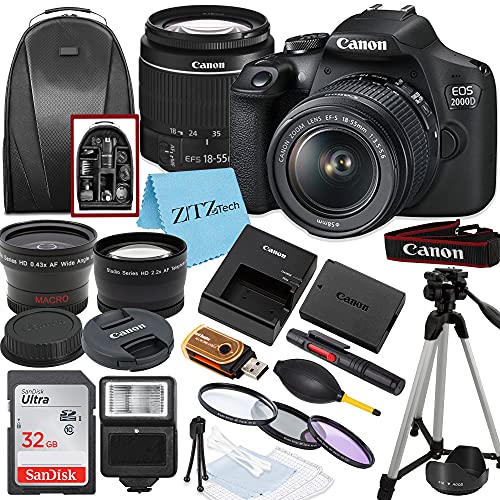
Canon EOS 2000D / Rebel T7 DSLR Camera with EF-S 18-55mm Lens + SanDisk 32GB Card Tripod Case Wideangle Lenses ZeeTech Accessory Bundle (20pc Bundle) (18-55MM, Card) Black (Renewed)
Check price on Amazon
Canon EOS Rebel T7 DSLR Camera with 18-55mm Lens Bundle | For Beginner Photography | 24.1MP APS-C DSLR Camera | Built-in Wi-Fi & NFC + 64GB Memory Card + Camera Bag
Check price on Amazon
Nikon D3100 14.2MP DSLR Camera with AF-S DX 18-55mm f/3.5-5.6 VR Zoom Lens - (Black) (Discontinued) (Renewed)
Check price on Amazon
Canon EOS Rebel T7 DSLR Camera Bundle – EF-S 18-55mm Lens, 64GB Memory Card, LED Video Light, Tripod, Camera Case & Accessories Kit (Renewed)
Check price on Amazon
Canon EOS 2000D / Rebel T7 DSLR Camera w/EF-S 18-55mm f/3.5-5.6 Lens 3 Lens Kit: 128GB Memory + Wide Angle + Telephoto + Flash (Renewed)
Check price on AmazonEssential Lenses for Your First DSLR
Your camera kit lens (usually 18-55mm) is a great start, but adding a couple of lenses will dramatically expand your creative options. Here are the most valuable additions for beginners.
The Nifty Fifty (50mm f/1.8)
A 50mm prime lens is affordable, sharp, and perfect for portraits and low-light photography. Its wide aperture creates beautiful background blur (bokeh). Learn why primes are so powerful in our Prime vs Zoom Lenses guide.
A Telephoto Zoom (70-300mm)
For wildlife, sports, or compressing landscapes, a telephoto zoom is invaluable. It lets you get closer to distant subjects without moving. Pair it with our wildlife photography guide to make the most of it.
A Wide-Angle Lens (10-18mm or similar)
Ideal for landscapes, architecture, and tight interiors. A wide-angle lens exaggerates perspective and lets you fit more into the frame. Check our landscape photography guide for techniques.
Macro Lens
If you are fascinated by tiny details, a dedicated macro lens opens up a world of insects, flowers, and textures. Read our macro photography guide to get started.
Budget Tip: You do not need to buy all lenses at once. Start with the kit lens and a 50mm f/1.8, then expand as your skills and interests grow.
Mastering Your DSLR: Settings and Techniques
Once you have your camera, the real fun begins. Understanding the exposure triangle—aperture, shutter speed, and ISO—is the foundation of all photography. Our Exposure Triangle Guide explains this in detail.
Start by shooting in Aperture Priority (Av/A) mode, which lets you control depth of field while the camera handles shutter speed. As you gain confidence, move to Manual mode. Practice these core techniques:
- Composition: Learn the rule of thirds, leading lines, and framing. See our Composition Rules.
- Focus: Master single-point AF and back-button focus for sharp subjects. Read our Focus Techniques.
- Lighting: Understand natural light and how to use a simple LED flash or reflector. Explore our Lighting Techniques.
- White Balance: Learn to set custom white balance for accurate colors. See our White Balance Guide.
For creative effects, experiment with long exposures using a camera tripod and ND filters like the ND4 filter. Our Long Exposure Guide will walk you through it.
After the Shoot: Workflow and Sharing
Your workflow doesn't end when you put the camera down. Organizing and editing your photos is part of the creative process. Start with a reliable Photo Editing Workflow and consider a Photo Archive Workflow to keep your growing library safe.
If you shoot video, our Video Editing Workflow will help you turn clips into polished stories. For those aiming to go pro, a Portfolio Building Guide and Client Delivery Workflow are essential reads.
Don't forget to back up your files! A good camera backpack and a camera bag will keep your gear safe on the go. And for peace of mind, review your warranty information.
Ready to Start Your Photography Journey?
Browse our curated selection of beginner-friendly DSLR cameras and start capturing amazing images today.
SHOP DSLR CAMERASExplore More Photography Resources
Deepen your knowledge with our other expert guides:
- Camera Starter Hub – Your central resource for beginners.
- Highest Rated Cameras – See what the community loves.
- Editor's Choice Cameras – Our top recommendations.
- Community Favorite Cameras – Popular picks among enthusiasts.
- New Camera Releases – Stay updated on the latest gear.
- Trending Camera Gear – What's hot right now.
- Photography Style & Technique Hub – Master your craft.
- Street Photography Guide – Capture candid moments.
- Black & White Guide – The art of monochrome.
- Film Emulation Guide – Recreate classic film looks.
- HDR Photography Guide – High dynamic range techniques.
- Color Theory in Photography – Use color effectively.
- Digital Camera Guide – General digital camera info.
- SLR Cameras – Learn about the broader SLR category.
- Camera Lens Guide – Understand lenses better.
- Photography Equipment – Essential gear overview.
- Camera Shop – Find trusted retailers.
- Camera Store – Another shopping resource.
- Photography Shop – More buying options.