
Mirrorless Camera for Sports Photography
Capture every split-second moment with confidence. Learn how to choose the right mirrorless camera for fast-action sports, from autofocus speed to burst rates and buffer depth.
View Recommended CamerasWhy mirrorless for sports? Mirrorless cameras have revolutionized sports photography by offering lightning-fast autofocus, high-speed burst shooting, and silent operation. Unlike traditional DSLRs, mirrorless systems use on-sensor phase detection and AI-driven subject tracking to lock onto athletes with remarkable precision. Whether you're shooting track and field, soccer, motorsports, or basketball, the right mirrorless camera can mean the difference between a blurry miss and a career-defining shot.
Key Features to Look For in a Sports Mirrorless Camera
Before diving into specific models, it's essential to understand the technical specifications that matter most for sports photography. Not every mirrorless camera is built for action — here's what separates the contenders from the pretenders.
⚡ Autofocus Speed & Tracking
Sports photography demands autofocus that locks on instantly and tracks subjects reliably. Look for cameras with AI-based subject detection (human, animal, vehicle), eye-tracking, and a high density of phase-detection points covering the frame. The best systems can acquire focus in under 0.05 seconds and maintain it through rapid movement.
📸 Burst Shooting Rate
To freeze a sprinter mid-stride or capture a soccer ball at the moment of impact, you need a camera that shoots at least 10 frames per second (fps). Professional-grade sports mirrorless cameras can reach 20–40 fps with electronic shutter, giving you a wider selection of peak-action moments to choose from.
🧠 Buffer Depth
Burst speed means nothing if your camera locks up after one second. Buffer depth determines how many consecutive RAW or JPEG frames you can shoot before the camera slows down. For sports, aim for a buffer that handles at least 100 JPEGs or 50 RAW files consecutively — more if you shoot professionally.
🔍 Viewfinder & Blackout
Electronic viewfinders (EVFs) in mirrorless cameras can suffer from blackout during continuous shooting, making it hard to track fast subjects. Modern sports-oriented models offer blackout-free or minimal-blackout EVFs with high refresh rates (120Hz+) so you never lose sight of the action.
🔋 Battery Life & Ergonomics
Long sports events demand batteries that last. Look for cameras with 500+ shot battery life, and consider battery grips for extended shoots. Ergonomics also matter — a comfortable grip and well-placed controls let you react instantly when the moment arrives.
🌐 Lens Ecosystem
Your camera is only as good as the glass in front of it. For sports, you'll need fast telephoto lenses (70-200mm f/2.8, 100-400mm, 400mm f/2.8) with quick linear motors. Check that your chosen mirrorless mount has a mature lineup of sports-ready lenses. If you're comparing systems, our guide on full-frame sensors explains how sensor size affects reach and low-light performance.
How to Choose the Right Mirrorless Camera for Your Sport
Different sports place different demands on your gear. A camera that excels at indoor basketball might struggle at an outdoor track meet. Here's how to match your camera to your sport.
🏃 Track & Field / Running
You need blazing-fast autofocus and high burst rates to capture the perfect stride. A camera with subject-tracking that locks onto the athlete's torso or eyes is ideal. If you're just starting out, a beginner camera for sports photography can still deliver impressive results without the professional price tag.
⚽ Soccer / Football
The ball moves unpredictably, and players constantly cross the frame. You need wide AF coverage, fast subject switching, and a deep buffer for continuous shooting. A professional-grade camera with dual card slots is highly recommended for redundancy.
🏀 Basketball / Indoor Sports
Indoor lighting is challenging. Prioritize cameras with excellent high-ISO performance (clean images at ISO 3200–6400) and fast primes like 85mm f/1.8 or 135mm f/2. Full-frame sensors generally outperform smaller formats in these conditions.
🏎️ Motorsports
Vehicles move fast and require predictive autofocus. Look for cameras with vehicle-specific subject detection and telephoto lenses with fast linear motors. A mirrorless camera for wildlife photography often shares the same strengths — long reach, fast AF, and rugged build.
Mirrorless Camera Comparison for Sports Photography
The table below compares key specifications across different tiers of mirrorless cameras suitable for sports. Prices reflect current market rates for body-only configurations.
| Camera Tier | Burst Rate | Autofocus System | Buffer (RAW) | Price Range | Best For |
|---|---|---|---|---|---|
| Entry-Level | 8–11 fps | Phase-detection, eye AF | ~30–50 frames | $800–$1,200 | Beginners, casual sports |
| Mid-Range | 12–20 fps | AI subject tracking, animal/vehicle detection | ~50–100 frames | $1,500–$2,500 | Enthusiasts, semi-pro |
| Professional | 20–40 fps | Advanced AI tracking, blackout-free EVF | 100–200+ frames | $2,500–$4,500 | Professional sports shooters |
| Flagship | 30–120 fps | Deep-learning AF, pre-capture | 200–1000+ frames | $4,500–$6,500 | Elite sports & photojournalism |
Mirrorless vs. DSLR for Sports: Pros and Cons
Mirrorless cameras have largely caught up to — and in many ways surpassed — DSLRs for sports photography. But there are still trade-offs to consider.
✅ Advantages of Mirrorless
- Silent shooting with electronic shutter — ideal for golf, tennis, and indoor events
- AI-powered subject detection and tracking that DSLRs can't match
- Higher burst rates (20–40 fps) without mirror slap vibration
- Blackout-free viewfinders in top-tier models
- More compact and lighter than equivalent DSLR setups
- Real-time exposure preview in the viewfinder
⚠️ Disadvantages of Mirrorless
- Electronic viewfinder lag can still be an issue in low-end models
- Battery life is generally shorter than DSLRs
- Older mirrorless bodies may have rolling shutter distortion
- Native telephoto lens options are still catching up in some mounts
- Higher initial investment for professional-grade bodies
Essential Lenses for Sports Photography
Your camera body is only half the equation. Sports photography lives and dies by your lens choice. Here are the focal lengths and types you should consider.
70-200mm f/2.8
The workhorse of sports photography. This versatile zoom covers portraits, medium telephoto, and action shots with a fast constant aperture. Perfect for basketball, soccer, and track. Pair it with a teleconverter to extend reach when needed.
100-400mm f/4.5-5.6
Ideal for outdoor sports where you need extra reach without breaking the bank. Great for soccer, baseball, and motorsports. The variable aperture is a trade-off, but modern sensors handle higher ISOs well.
400mm f/2.8 or 600mm f/4
Professional-grade super-telephotos for field sports and wildlife. These lenses deliver stunning subject isolation and sharpness, but they're heavy and expensive. Expect to pay $8,000+ for these optics.
85mm f/1.8 or 135mm f/2
Fast primes for indoor sports and low-light gyms. Their wide apertures let in more light, allowing faster shutter speeds and cleaner high-ISO images. Excellent for basketball and volleyball.
Recommended Mirrorless Cameras for Sports Photography
⚠️ AFFILIATE DISCLOSURE: This website contains affiliate links. As an affiliate Associate, we earn from qualifying purchases. If you make a purchase through these links, we may receive a small commission at no additional cost to you. Read our full affiliate policy.
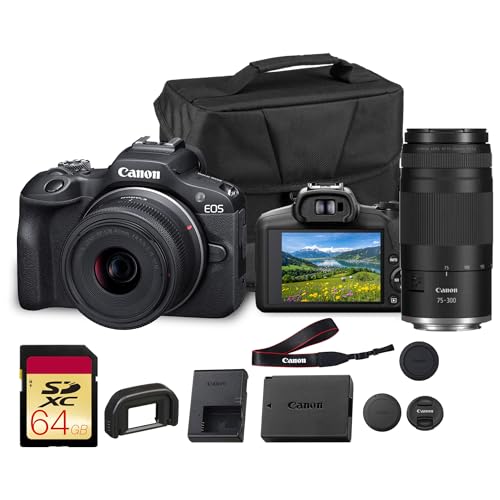
Canon EOS R100 Mirrorless Camera with 18-45mm & 75-300mm Double Lens Bundle | For Photography & Video | 24.2MP APS-C Mirrorless Camera | 4K Video | Dual Pixel Autofocus + 64GB Memory Card + Camera Bag
Check price on Amazon
Canon EOS R10 Mirrorless Camera with 18-150mm & 75-300mm Lenses Bundle | Travel Compact | For Photography & Video | 24.2MP APS-C Mirrorless Camera | 4K Video + 64GB Card + Camera Bag (5331C016)
Check price on Amazon
Canon EOS R50 Mirrorless Camera with 18-45mm Lens (5811C012) Bundle | For Photography & Video | APS-C Mirrorless Camera | 4K Video | Dual Pixel AF II + 64GB Memory Card + Camera Bag
Check price on Amazon
Canon EOS R6 Mark II Mirrorless Camera with 24-105mm Lens Bundle | For Photography & Video | 24.2MP Full-Frame Mirrorless Camera | 4K 60p Video + 64GB Memory Card + Camera Bag
Check price on Amazon
Sony Alpha a7 III Mirrorless Camera with 28-70mm Lens Black | 28-70mm with 3-Inch LCD
Check price on Amazon
Canon EOS RP Mirrorless Camera RF24-105mm Lens F4-7.1 is STM Lens Kit | Full-Frame Interchangeable Lens Camera, Compact & Lightweight for Traveling & Vlogging
Check price on Amazon
Canon EOS R7 Mirrorless Camera with 75-300mm Lens (5137C002) Bundle | For Wildlife & Sports | 32.5MP APS-C Mirrorless Camera | 4K 60p Video | In-Body Stabilization + 64GB Memory Card + Camera Bag
Check price on Amazon
Canon EOS R7 Mirrorless Camera (Body Only) | Hybrid Camera, 32.5 Megapixel (APS-C) CMOS Sensor, 4K Video, for Sports, Action, Content Creators, Vlogging Camera
Check price on AmazonFinal Verdict: Which Mirrorless Camera Is Right for You?
🏆 Our Recommendation
For most enthusiasts and semi-professional sports photographers, a mid-range mirrorless camera in the $1,500–$2,500 range offers the best balance of speed, autofocus intelligence, and value. Cameras in this tier deliver 15–20 fps burst shooting, advanced AI subject tracking, and solid buffer depths that handle most sporting events with ease.
If you're shooting professionally — especially for clients who demand peak-action frames — invest in a professional-grade body ($2,500–$4,500). The blackout-free EVF, deeper buffers, and superior build quality are worth the premium when your livelihood depends on getting the shot.
Beginners should start with an entry-level mirrorless camera ($800–$1,200) and focus on learning technique. A beginner camera for nature photography can double as a sports camera in good lighting, letting you build skills before upgrading. You can also explore cheap photography cameras for beginners to get started without a heavy investment.
Remember: the best camera is the one you have with you. A mid-range mirrorless with a fast 70-200mm lens will outperform a flagship body with a slow kit lens every single time.
Frequently Asked Questions
Yes, in most modern cases. Mirrorless cameras offer faster burst rates, AI-driven subject tracking, silent shooting, and blackout-free viewfinders that DSLRs cannot match. However, DSLRs still have advantages in battery life and native telephoto lens availability. For most sports photographers today, mirrorless is the superior choice.
For most sports, 10–15 fps is sufficient. For fast-action sports like track and field, motorsports, or professional soccer, aim for 20 fps or higher. Keep in mind that burst rate must be paired with a deep buffer — otherwise, the camera will slow down after a second or two.
f/2.8 is the gold standard for sports zooms because it balances light gathering, depth of field, and size. For indoor sports, f/1.8 or f/2 primes are better. For outdoor daytime sports, f/4 or f/5.6 lenses can work well and are more affordable.
Not necessarily. APS-C mirrorless cameras offer excellent sports performance at a lower price, and their crop factor gives you extra reach with telephoto lenses. However, full-frame cameras generally perform better in low light and offer shallower depth of field for subject isolation. Learn more in our full-frame guide.
Absolutely. Many modern mirrorless cameras excel at both stills and video. Look for models with 4K 60fps or higher, good autofocus in video mode, and sufficient battery life. If you're also interested in vlogging, check out our guide to the best 4K vlogging cameras.
Ready to Capture the Action?
Browse our curated selection of sports-ready mirrorless cameras above. Whether you're a beginner or a seasoned pro, there's a perfect camera waiting for you.
Shop Recommended CamerasPro Tip: When shooting sports, always use back-button focus (AF-ON) to separate focusing from shutter release. This gives you greater control over tracking and helps you capture the decisive moment without the camera refocusing unexpectedly. Pair this technique with continuous AF (AF-C) and a fast memory card (UHS-II or CFexpress) to clear your buffer quickly.