
Reflector for Camera: The Complete Guide to Perfect Lighting
Master the art of light manipulation. Discover how a simple reflector can transform your portraits, product shots, and outdoor photography from flat to phenomenal.
Shop Top ReflectorsWhy Every Photographer Needs a Reflector: A reflector for camera is one of the most affordable yet powerful tools in your kit. It bounces light back into shadows, adds dimension, and creates professional-looking results without expensive studio equipment. Whether you're shooting portraits, products, or outdoor scenes, a reflector gives you control over the light.
What Exactly Is a Camera Reflector?
A reflector for camera is a simple surface that bounces light back onto your subject. Unlike a flash that adds light, a reflector redirects existing light—whether from the sun, a window, or a studio strobe—to fill in shadows and create a more balanced exposure. It's an essential tool for any photographer looking to improve their lighting without a huge investment.
Reflectors come in various shapes, sizes, and colors. The most common are circular pop-up reflectors, which fold down compactly for travel, and rectangular panels, which offer broader coverage for full-body portraits or large product setups. Understanding which type suits your needs is the first step toward better lighting.
For photographers who want to take their lighting to the next level, combining a reflector with a camera ND filter or a CPL filter can help manage harsh light and reflections simultaneously. And if you're working with artificial light, a matte box can help control flare and stray light, making your reflector work even more effectively.
Types of Reflectors for Camera: Which One Is Right for You?
1. White Reflectors
The most versatile and natural-looking option. White reflectors bounce soft, neutral light that fills shadows without altering the color of your scene. Perfect for portraits and product photography where you want a clean, natural look.
- Soft, even fill light
- No color cast
- Ideal for beginners
- Great for outdoor portraits
2. Silver Reflectors
Silver reflectors produce a brighter, more specular light with higher contrast. They're excellent for creating punchy, high-fashion looks or when you need to bounce light over a long distance. Use them when you want more intensity and sparkle.
- High contrast and brightness
- Great for long-distance bouncing
- Adds sparkle to eyes
- Best for fashion and editorial
3. Gold Reflectors
Gold reflectors add a warm, golden tone to your subject. They're ideal for sunset portraits, adding warmth to skin tones, or creating a cozy, intimate mood. Use sparingly—too much gold can make skin look orange.
- Warm, golden light
- Perfect for sunset shoots
- Enhances skin tones
- Creates romantic mood
4. Silver/Gold Combo
Many reflectors come with a reversible cover offering both silver and gold surfaces. This gives you flexibility to switch between cool, bright light and warm, golden light depending on your scene and creative vision.
- Two reflectors in one
- Versatile for different scenes
- Space-saving for travel
- Great value for money
5. Black Reflectors (Flags)
Technically a "negative reflector," black panels absorb light rather than bounce it. They're used to create shadows, add depth, and prevent light from spilling onto areas you want to keep dark. Essential for dramatic, moody lighting.
- Creates shadows and depth
- Controls light spill
- Adds drama and contrast
- Perfect for low-key portraits
6. Translucent Reflectors (Diffusers)
Translucent panels are placed between the light source and subject to soften harsh light. They turn harsh sunlight into a soft, even glow, making them indispensable for outdoor portraits on bright days.
- Softens harsh sunlight
- Creates even, flattering light
- Reduces contrast
- Essential for outdoor shoots
How to Use a Reflector for Camera: Techniques That Work
Using a reflector effectively is about understanding the direction of light and the angle of reflection. The basic principle is simple: the angle of incidence equals the angle of reflection. Position your reflector so that it catches light from your main source and bounces it back toward your subject's shadowed side.
For portraits, hold the reflector at chest level or slightly below, angled upward toward the subject's face. This fills in shadows under the eyes, nose, and chin, creating a more flattering look. For full-body shots, use a larger reflector or position it further away to cover more area.
When shooting outdoors, the sun is your main light. Position your subject with the sun behind them or to the side, then use a reflector to bounce sunlight back onto their face. This creates a beautiful rim light effect while keeping the face well-lit. If the sun is too harsh, use a translucent diffuser to soften it first, then use a white reflector for fill.
For product photography, reflectors are invaluable for eliminating harsh shadows and creating clean, even lighting. Place a white reflector on the opposite side of your main light to fill in shadows and reveal detail. For shiny products, use a black reflector to control reflections and prevent unwanted glare.
If you're working with a monopod for camera or a tripod, you can often clamp a reflector to a magic arm for hands-free positioning. This is especially useful when shooting alone and you need precise control over your lighting setup.
Pros and Cons of Using a Reflector
✓ Advantages
- Extremely affordable compared to studio lights
- Portable and lightweight
- No power required—works anywhere
- Natural-looking results
- Versatile—multiple colors and sizes
- Easy to learn and use
- Perfect for outdoor and location shoots
✗ Limitations
- Requires an assistant or stand for best results
- Depends on available light source
- Can be difficult to control in windy conditions
- Large reflectors can be cumbersome to carry
- Not effective in very low light
- Can create uneven lighting if positioned incorrectly
Buying Guide: What to Look for in a Camera Reflector
When shopping for a reflector for camera, consider these key factors to ensure you get the right tool for your needs:
| Factor | What to Consider | Best For |
|---|---|---|
| Size | Small (12-24") for headshots; Medium (32-42") for portraits; Large (48"+) for full-body and groups | Match size to your typical subject |
| Shape | Circular for portability; Rectangular for broader coverage; Triangular for corner fill | Circular for travel; Rectangular for studio |
| Color | White for natural fill; Silver for brightness; Gold for warmth; Black for negative fill; Translucent for diffusion | Start with white or a 5-in-1 kit |
| Portability | Pop-up designs fold small; Panel reflectors are bulkier but more durable | Pop-up for travel; Panel for studio |
| Durability | Look for reinforced edges, quality fabric, and sturdy frames | Important if you shoot outdoors often |
| Price | Basic reflectors: $15–$40; 5-in-1 kits: $25–$60; Professional panels: $60–$200 | Start affordable, upgrade as needed |
Recommended Reflectors for Camera
⚠️ AFFILIATE DISCLOSURE: This website contains affiliate links. As an affiliate Associate, we earn from qualifying purchases. If you make a purchase through these links, we may receive a small commission at no additional cost to you. Read our full affiliate policy.

NEEWER 22 Inch/60 Centimeter Light Reflector Light Diffuser 5 in 1 | Multi Disc with Bag, Translucent, Silver, Gold, White, and Black, for Studio Photography Lighting and Outdoor Lighting
Check price on Amazon
WELLMAKING 32'' Reflector Photography with tilt Adapter for Studio Outdoor | 80cm Light Reflector 5in1, Two 1/4" Threads Grips, Collapsible with Bag, Folds to 12in, One-Hand Use, Portraits and Streaming
Check price on Amazon
Round Folding Portable Photography Reflector, 2 in 1 Lighting Reflectors, Camera Photo Reflector Diffuser, Light Reflectors for Portrait Photography, Still Life Fill Light (18inch/45cm, Silver, White)
Check price on Amazon
K&F CONCEPT 5-in-1 Light Reflector, 22"/60cm with Handle Grip & Bag | Collapsible Portable Photography Diffuser for Studio and Outdoor Lighting, Gold/Silver/White/Black/Translucent LE04
Check price on Amazon
K&F CONCEPT 24" x36” 5-in-1 Oval Foldable Reflector, With Carrying Bag | Gold/Silver/Black/White Reflective Fabric and Translucent Soft Fabric, for Studio Lighting LE07
Check price on Amazon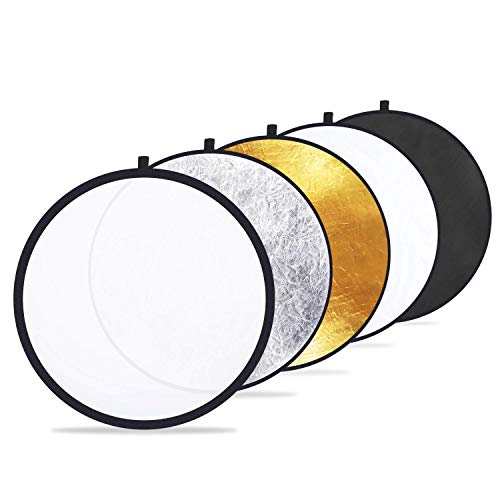
Etekcity 24" (60cm) 5-in-1 Photography Reflector, Multi-Disc Light Reflectors for Photography, Collapsible with Bag - Translucent, Silver, Gold, White and Black
Check price on AmazonReflector Techniques for Different Photography Styles
Portrait Photography
In portrait photography, a reflector is your secret weapon for flattering light. Position a white reflector below the subject's face to fill in shadows and create catchlights in the eyes. For a more dramatic look, use a silver reflector from the side to create a split-lighting effect. If you're shooting outdoors in harsh sunlight, use a translucent diffuser above the subject to soften the light, then a white reflector for fill.
For a more professional setup, consider using a 50mm prime lens with a wide aperture to create beautiful background separation while your reflector fills in the shadows. This combination is a staple for portrait photographers.
Product Photography
Product photography demands clean, even lighting. Use a large white reflector on the opposite side of your main light to eliminate shadows and reveal detail. For products with reflective surfaces, use a black reflector to control unwanted reflections. If you're shooting small products like jewelry, a photoshoot box combined with a reflector creates a mini studio environment for professional results.
Outdoor and Landscape Photography
While reflectors are less common in landscape photography, they're invaluable for outdoor portraits. When shooting against a bright sky or sunset, use a reflector to bounce light back onto your subject's face. For nature photography, a camera for astrophotography setup might not need a reflector, but for wildlife and bird photography, a reflector can help fill shadows in harsh midday light.
Video and Vlogging
For video work, reflectors are just as important as for still photography. They provide continuous, natural-looking light that's flattering on camera. If you're a vlogger using a 4K vlogging camera, position a reflector in front of you to fill in shadows and create an even, professional look. A camera monitor can help you see exactly how the light is falling on your subject.
Common Mistakes to Avoid When Using Reflectors
1. Positioning the reflector too high or too low: This creates unnatural shadows. Keep the reflector at chest level or slightly below for natural-looking fill.
2. Using a silver reflector when white would be better: Silver is very bright and can create harsh, unflattering light. Start with white and only use silver when you need extra punch.
3. Forgetting about color temperature: Gold reflectors add warmth, which can be flattering for skin tones but may clash with cool-toned scenes. Match your reflector to your white balance.
4. Not using a reflector at all: Many photographers rely solely on natural light and end up with flat, shadowy images. A reflector is one of the cheapest ways to dramatically improve your photography.
5. Ignoring the background: A reflector can bounce light onto your background as well as your subject. Be aware of how it affects the entire scene, not just the main subject.
Frequently Asked Questions About Camera Reflectors
What is the best size reflector for portraits?
For headshots and half-body portraits, a 22-32 inch reflector is ideal. For full-body portraits, you'll want a 42-inch or larger reflector. If you're just starting out, a 32-inch 5-in-1 reflector is a versatile choice that covers most situations.
Can I use a reflector with a smartphone camera?
Absolutely! A reflector works with any camera, including smartphones. If you're using a digital camera for photography or a smartphone, a reflector can dramatically improve your lighting. Just position it the same way you would with a DSLR or mirrorless camera.
Do I need an assistant to use a reflector?
Not necessarily. You can clamp a reflector to a light stand, a magic arm, or even a tree branch using a clamp. However, having an assistant makes it much easier to adjust the reflector in real-time as you shoot.
What's the difference between a reflector and a diffuser?
A reflector bounces light back onto the subject, while a diffuser softens and spreads the light source. Many 5-in-1 reflector kits include a translucent diffuser panel, so you get both tools in one package.
Can I use a reflector for video recording?
Yes! Reflectors are excellent for video because they provide continuous, natural-looking light. Whether you're using a video recorder camera or a camcorder camera, a reflector will improve your lighting quality.
Final Thoughts: Why a Reflector Belongs in Every Camera Bag
A reflector for camera is one of the most cost-effective investments you can make in your photography. It's lightweight, portable, and requires no power—yet it can dramatically improve the quality of your images. Whether you're shooting portraits, products, or outdoor scenes, a reflector gives you control over light that you simply can't achieve with natural light alone.
If you're just starting out, a 5-in-1 reflector kit is the perfect introduction. It gives you white, silver, gold, black, and translucent options in one package, so you can experiment with different looks and find what works best for your style. As you grow as a photographer, you can add larger reflectors or specialized panels to your kit.
Remember, great photography is all about light. Master your reflector, and you'll master your light. Whether you're using a beginner photography camera or a professional DSLR camera, a reflector will help you take your images to the next level.
Ready to get started? Check out our recommended reflectors above and start transforming your photography today.